
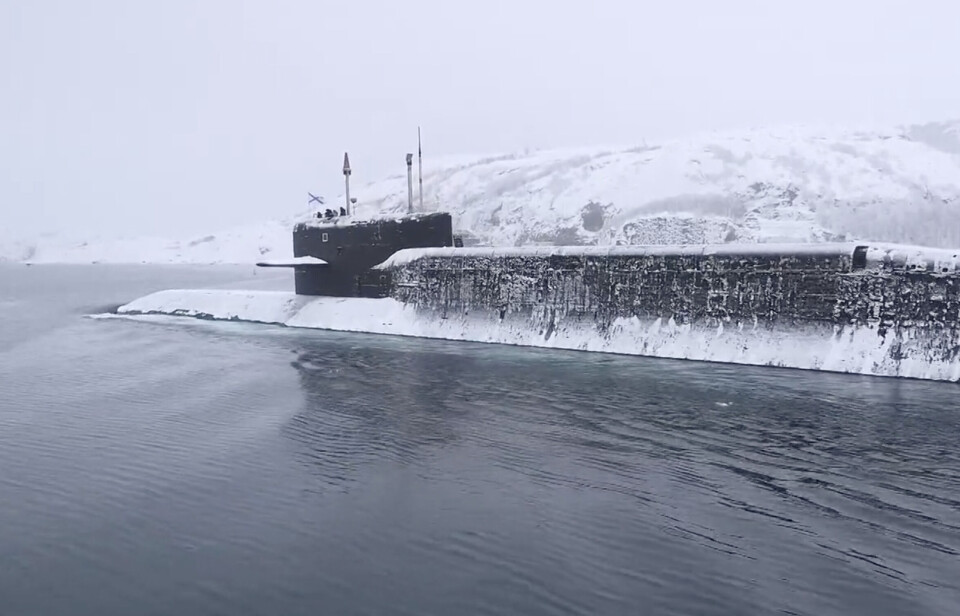
Putin's favorite submarine returns to service, fueling Arctic nuclear buildup
Karelia is the submarine on which Vladimir Putin - then acting president - spent a night at a depth of 50 metres in the Barents Sea in April 2000. Now upgraded, the vessel is preparing for deterrence patrols and is expected to remain in service until 2038.
The expiry of the New Strategic Arms Reduction Treaty (New START) in February marked the end of formal limits on strategic nuclear weapons held by Russia and the United States.
If Moscow opts to expand its naval nuclear forces, Karelia (K-18) could become the first additional platform deployed with the Northern Fleet without replacing an existing vessel. In practical terms, this would mean more ballistic missiles - and more nuclear warheads - on alert in the Barents Sea and the wider Arctic.
While Russia has, over the past decade, introduced several fourth-generation ballistic missile submarines of the Borei and Borei-A classes, it has also prioritised extending the service life of older Soviet-era Delta IV-class vessels assigned to the Northern Fleet.
Karelia was laid down in 1987, the same year that Mikhail Gorbachev delivered his landmark Murmansk speech. Addressing an audience in the Arctic city, he set out a vision of the region as a “zone of peace”, signalling a shift in Kremlin policy from military confrontation towards cooperation.
The submarine’s flag-hoisting ceremony took place on 11 October 1989, just weeks before the fall of the Berlin Wall.
Today, Karelia appears to hold particular symbolic significance for Vladimir Putin. Not only is it among the last ballistic missile submarines built by the Soviet Union - a union whose collapse later was described by Putin as the “greatest geopolitical catastrophe of the 20th century” - it also featured in his first official trip after his initial election victory in March 2000.
Between 5 and 6 April that year, the president-elect spent a night aboard Karelia while it was submerged in the Barents Sea. During the visit, he observed a Northern Fleet exercise that included the launch of a ballistic missile from the Delta III-class submarine Borisoglebsk (K-496).
Speaking to officers at Northern Fleet headquarters in Severomorsk, Putin was quoted by the state news agency ITAR-TASS as saying: “Russia cannot survive without your service.”


Ukraine war
Twenty-two years later, on 19 February 2022, Putin again placed Karelia at the centre of a strategic nuclear exercise known as Grom (“Thunder”). During the drills, a Sineva ballistic missile was launched from the submarine while it was submerged in the Barents Sea.
The exercise was intended to signal Russia’s nuclear capabilities at a time of heightened geopolitical tension. Five days later, Putin ordered a full-scale invasion of Ukraine.
On 27 February, after it became clear that Kyiv would not fall within days, he instructed Defence Minister Sergei Shoigu and Chief of the General Staff Valery Gerasimov to place Russia’s strategic nuclear forces on a “special regime of combat duty”.
Since then, Moscow has repeatedly employed nuclear rhetoric as a strategic tool, seeking to deter Western support for Ukraine and warning of potential escalation should NATO become directly involved.
Ready for deterrence patrols
In recent years, Karelia has been undergoing extensive modernisation at the Zvezdochka shipyard in Severodvinsk. Work has included refuelling its two nuclear reactors, refurbishing missile tubes, and carrying out a range of technical upgrades.
A video released this week by the Northern Fleet’s press service shows the crew preparing for a new deterrence patrol. The footage has been widely republished by state-controlled media, including GTRK Murman and TASS.
The message is unmistakable. Karelia carries 16 Sineva ballistic missiles, each with a range of up to 11,500 kilometres - placing targets across the Northern Hemisphere within reach in around 30 minutes.
With the latest modernisation, Karelia will remain in service until 2038. If so, the submarine will then be 49 years old - making it one of the oldest nuclear-powered vessels in the history of underwater warfare.
More nuclear weapons in the Arctic
In Washington, D.C., the U.S. intelligence community this week published its 2026 Annual Threat Assessment, highlighting the Arctic’s central role in Russia’s nuclear deterrence.
According to the report, the Kola Peninsula hosts “about two-thirds of Russia’s second-strike nuclear capabilities”.
All seven of the Northern Fleet’s ballistic missile submarines are based at Gadzhiyevo, north of Murmansk and roughly 100 kilometres from the Norwegian border. Additional missile-handling infrastructure is located in Okolnaya Bay, near Severomorsk. The peninsula also hosts several storage facilities for naval nuclear weapons, as well as one of Russia’s central warhead depots.
In testimony before the U.S. House Armed Services Committee on Strategic Forces, Commander Richard Correll presented updated unclassified estimates of Russia’s nuclear arsenal:
With no New START treaty in force, there are now no legally binding limits on the total number of deployed nuclear warheads. This has raised concerns that Russia could increase the number of weapons assigned to forces on the Kola Peninsula.
“I think this is a real and serious concern,” said Norwegian Prime Minister Jonas Gahr Støre when asked by the Barents Observer in February about the possibility of a further nuclear build-up near Norway’s northern border.
Each of the 16 Sineva missiles carried by Karelia can be armed with four nuclear warheads, bringing the total number of nukes on the submarine to 64.


